
Share This

It’s a Friday, one of the 365 days that you live in a year. You get in a Fish and Chips takeaway, order your meal and wait to be served. Then you think, why don’t I check in Foursquare and share my location on Facebook to let everyone know that I am getting a Fish and Chips tonight? That was me, I checked in, no one interacted with me. I soon realised that it was my first checkin after seven months and probably the first one in something close to a restaurant.
Foursquare seems to be a walking dead, which is able to raise capital, probably thanks to a good network of people, but still lacks of traction. They haven’t realised that the only good thing they have is the API, which has been used by the majority of apps that needs a quick geolocation feature. There is a difference between being a product and a feature, they are the second one.
Although Foursquare is navigating in open waters, the problem we are trying to address is the one referred to geolocation apps and the market around it. We have seen plenty of companies and products trying to solve this issue and connecting people through their location, but no one has really succeeded. The main reason is because location is simply a mere feature that bigger networks of people, such as Facebook, can have.
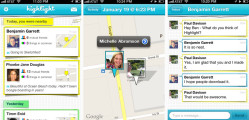
There is no reason to move to Foursquare, check in and then share your location on Facebook, when you can both check in and interact with the people who start a conversation on your post within the same app. On the other hand, if we look at apps such as Highlight, we see that people are still scared of sharing automatically where they are and what they do. There is a slice of population that isn’t ready to share everything yet.
On the same wavelength, Glympse is trying to approach the problem from a different side by letting people share their location, with who they want in a determined timeframe. Even though the idea is pretty interesting and can have dozens of applications, including in the workspace, is geolocation still to be considered a market?
It seems silly but people are more willing to upload five personal pictures, add a short bio and start getting rated by other people, instead of sharing their own location with the people they care about. When they share, it’s not to reach other people, but to show off. Social networks are there to make people more beautiful, not to show who they really are.
No one would have checked in a fish and chips place, simply because it’s sticky, it does smell and it’s not cool at all. The average checkin is on top of a skyscraper or in a really cool bar. The initial aim of implementing geolocation apps to connect people and make them find other friends is failing and no one has been able to solve that problem.
Even if I can still see the nice checkin on top of a skyscraper, I won’t be able to reach that person. What these startups need to aim at is the silly checkin made in the fish and chips place, because it creates social interactions (even though mine didn’t). It’s easier to try to connect with someone who’s getting some food near you than someone who’s showing off.
The market is still open. There are dozens of companies that have raised millions of dollars to try to figure out this “wicked problem”, but there is no final winner, if we don’t want to consider Facebook as being one.